Pick 4130 when the part will be welded or must stay tough in thin sections — frames, brackets, tube fittings, weld-on lugs. Pick 4140 when the part is a solid machined component that needs higher strength and hardness through a thicker section — shafts, pins, gears, axles, tooling. The difference comes from carbon: roughly 0.28–0.33 % for 4130 versus 0.38–0.43 % for 4140.
Both are chromium-molybdenum ("chromoly") low-alloy steels and look identical on the shelf. Their European counterparts are 25CrMo4 (1.7218) and 42CrMo4 (1.7225); in Japan, SCM430 and SCM440. This guide focuses on the choice between them. For machining and heat treating 4140 itself, see our separate 4140 guide.
Composition and equivalents
The alloying of the two grades is nearly the same — about 0.8–1.1 % chromium and 0.15–0.25 % molybdenum in the AISI/SAE ranges — so the carbon level does most of the work. More carbon means higher achievable hardness and strength after quenching and tempering, but also more risk of cracking when welded and less toughness at the same hardness.
- AISI/SAE 4130 ≈ EN 25CrMo4 (1.7218) ≈ JIS SCM430. Carbon roughly 0.28–0.33 %.
- AISI/SAE 4140 ≈ EN 42CrMo4 (1.7225) ≈ JIS SCM440. Carbon roughly 0.38–0.43 % (42CrMo4 allows 0.38–0.45 %).
- Equivalents are close, not identical: EN ranges and the delivery condition codes (+A, +N, +QT) differ from ASTM bar standards, so name the standard on critical parts.
Hardenability and section size
Hardenability is how deep a steel hardens when quenched. 4140 hardens more deeply than 4130, so a 4140 shaft of moderate diameter can reach a useful hardness through most of its section, while a thick 4130 part will be noticeably softer in the core. This is why 4130 is common as tube and thin plate, and 4140 as round bar for solid parts.
For a solid machined part, the question is: what strength do you need at the centre of the largest section? If the answer is "not much" — a bracket, a clamp, a lightly loaded spacer — 4130 or even plain carbon steel may be enough. If a shaft carries torsion and bending, 4140 in quenched-and-tempered condition is the usual starting point.
Welding: the main reason to choose 4130
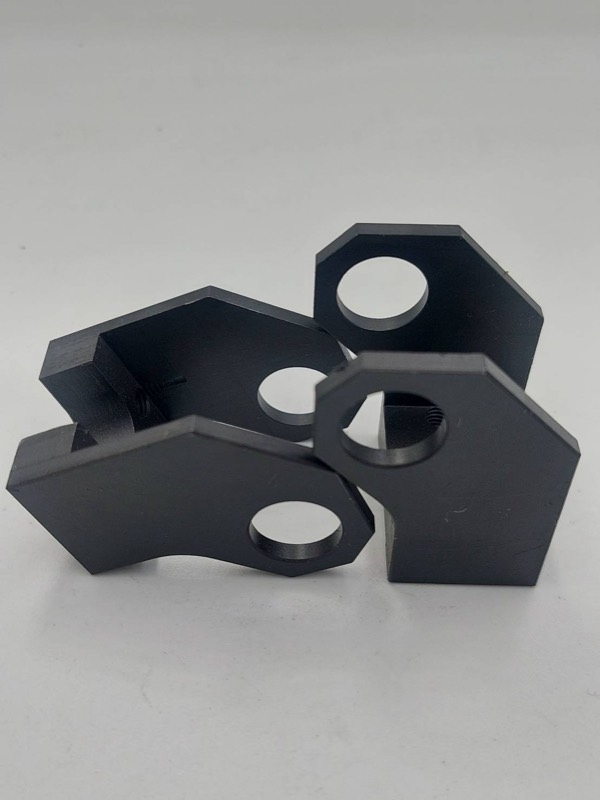
Thin-wall 4130 tube is routinely TIG welded in bicycle, motorsport and light aircraft structures, often without preheat for thin walls. Thicker 4130 sections need preheat to avoid hard, brittle zones and hydrogen cracking. 4140 is much less forgiving: welding it calls for higher preheat, controlled interpass temperature and normally post-weld heat treatment. If a machined part is going to be welded into an assembly — a weld-on dropout, a bung, a mounting tab — 4130 is the safer specification.
Typical uses for each grade
- 4130: bicycle and motorsport frames, roll cages, tube junctions and fittings, weld-on brackets and lugs, light structural parts where welding and toughness matter more than peak hardness.
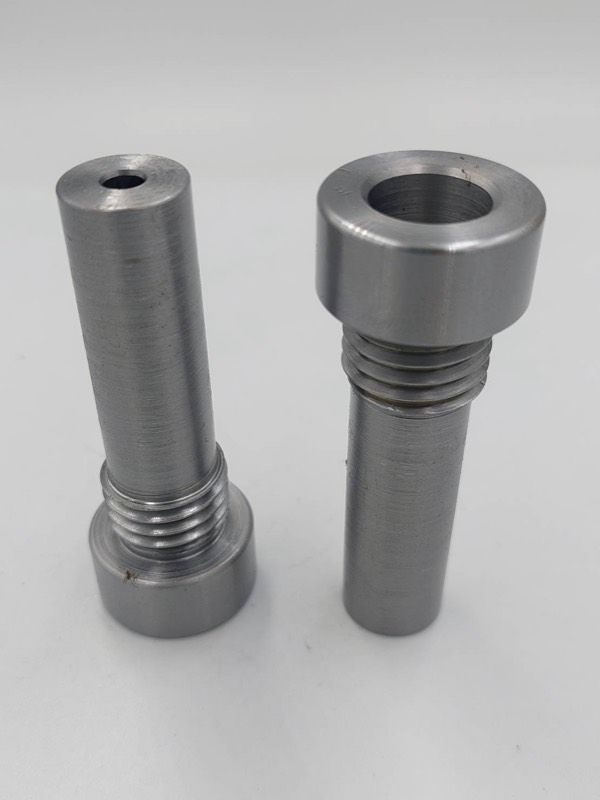
- 4140: shafts, axles, pins, gears, spindles, bolts and studs, hydraulic and tooling components, fixtures and parts that are surface hardened on wear areas.
- Both: machined parts that need more strength than mild steel and accept a coating (black oxide, zinc, nickel) for corrosion protection.
Supply condition and machinability
Each grade can be bought annealed, normalized, or quenched and tempered. Annealed bar machines easily and is the normal choice if parts are heat treated afterwards. Quenched-and-tempered bar is machined in its final strength range, avoiding post-machining distortion at the cost of slower cutting. 4130 tube is often supplied normalized.
At the same condition, 4130 usually cuts a little more easily than 4140 thanks to its lower carbon, and it tends to be slightly gummier when fully annealed. Neither is free-machining. Both rust quickly once cut, so unfinished parts must be oiled for storage and export.
- If you need a hardness range, give it in HRC or HB with tolerance (e.g. "28–32 HRC") rather than just "heat treated".
- Hardened parts may distort; leave grinding stock on bearing seats and close fits if heat treatment follows machining.
- Plated chromoly parts at higher hardness can be susceptible to hydrogen embrittlement; ask the plater about a post-plating bake.
Drawing callout examples
Write grade, standard and condition in one line so a supplier in any country can buy the right bar:
- "AISI 4130 (25CrMo4 / 1.7218), normalized" — welded bracket or fitting.
- "AISI 4140 (42CrMo4 / 1.7225), quenched and tempered, 28–32 HRC" — shaft machined from pre-hardened bar.
- "AISI 4140, annealed; harden and temper to 40–45 HRC after machining; grind Ø20 g6 after heat treatment" — part needing higher hardness.
- Add the finish (black oxide, zinc + passivate, oil only) and whether an EN 10204 3.1 inspection document is required.
Chromoly steel parts at Chi Xin
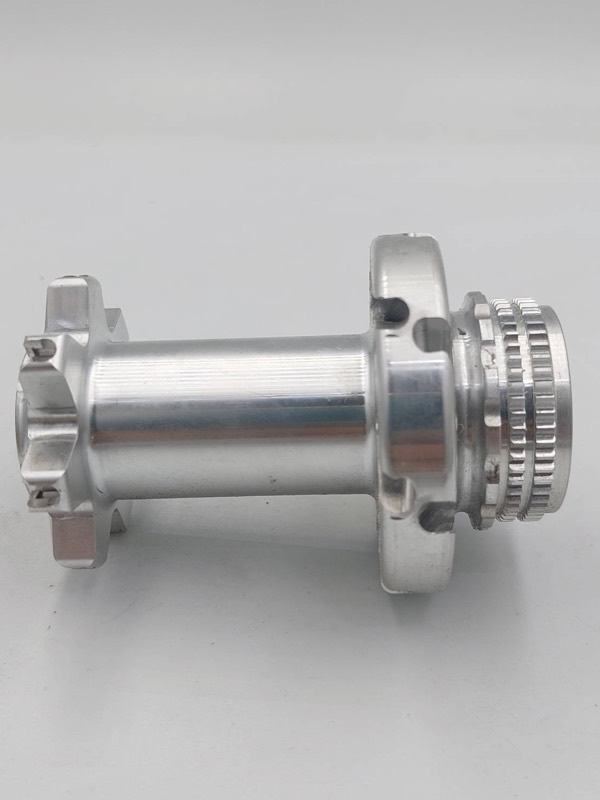
Chi Xin Technology is a CNC machine shop in Nantun District, Taichung, Taiwan, founded in 2022. We run 5+ CNC machines — 4.5-axis CNC machining centers and CNC lathes — and mainly machine aluminum alloys and alloy steel, with a metal tolerance of 0.02 mm. We also offer wire EDM and surface finishing including anodizing, and we export to customers in Europe and North America.
Alloy steel is one of our main materials, turned and milled on CNC lathes and 4.5-axis machining centers; if your 4130 or 4140 part needs a specific condition, heat treatment or coating, tell us in the RFQ and we confirm in the quotation.
Frequently asked questions
Is 4140 stronger than 4130?
In the same heat-treated condition 4140 can reach higher strength and hardness because it has more carbon, and it hardens more deeply in thick sections. In thin welded structures 4130 is usually the better overall choice.
Can I weld a 4140 part?
It is possible but needs preheat, controlled interpass temperature and usually post-weld heat treatment. If welding is part of the design, 4130 or a lower-carbon steel is simpler and less risky.
What is the European equivalent of 4130?
25CrMo4, material number 1.7218. For 4140 it is 42CrMo4, 1.7225. They are close equivalents, not exact matches, so state the standard on critical parts.
Should I buy pre-hardened bar or heat treat after machining?
If the hardness you need is available in quenched-and-tempered bar, machining from it avoids distortion and an extra process. If you need higher hardness or a hardened wear surface, machine annealed and heat treat afterwards, with finishing stock on precise features.