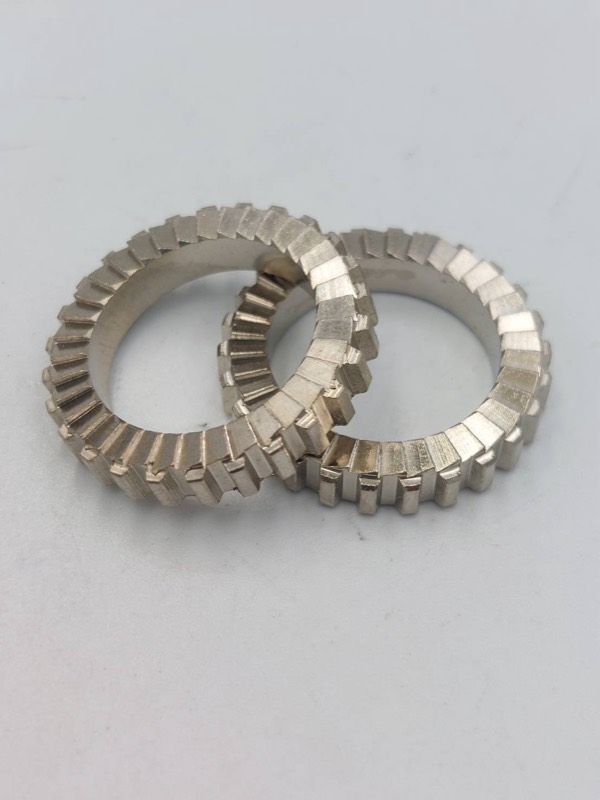
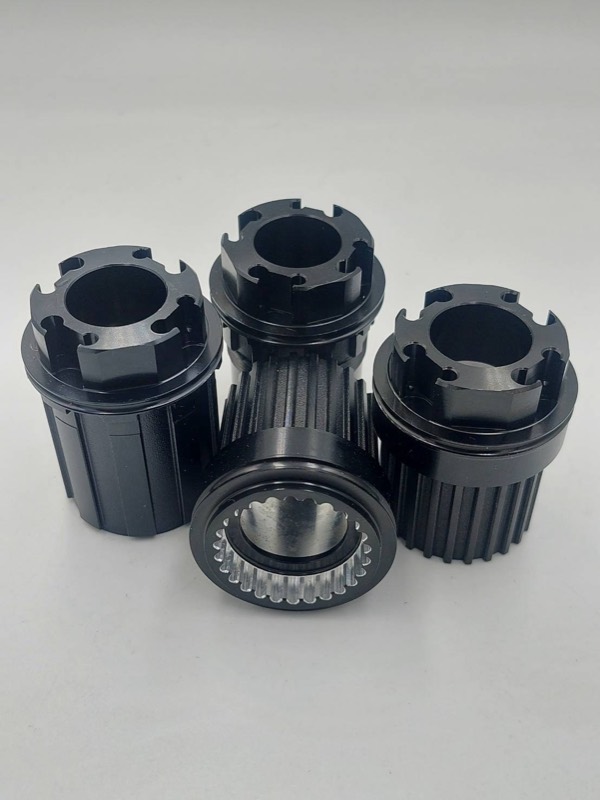
To design a part for wire EDM, keep inside corners at or above the wire radius plus the spark gap (roughly 0.07–0.2 mm with common wires), add a start hole for every closed profile, keep the material electrically conductive, and tolerance only the profiles that need it, because each extra skim pass adds time. Outside corners can be sharp; inside corners cannot.
Wire EDM cuts a 2D profile through the full thickness of the part with a thin, travelling wire and electrical sparks, with no cutting force. That makes it ideal for splines, ratchet teeth, narrow slots and profiles in hardened steel — but it has its own design rules. If you are still deciding whether to wire cut or mill a feature, read our wire EDM vs CNC milling guide first.
Wire diameter and the kerf
Most production wire EDM uses brass or coated brass wire, commonly in diameters from 0.1 mm to 0.3 mm, with 0.25 mm as an everyday size. Finer wires (0.1–0.15 mm, and even smaller on micro-EDM machines) allow smaller corners but cut more slowly and break more easily in thick parts.
The slot the wire leaves — the kerf — is the wire diameter plus a spark gap on each side, typically a few hundredths of a millimetre per side. The machine offsets the path automatically, so you draw the finished part, not the wire path.
Inside corners, outside corners and slots
The smallest inside corner radius equals the wire radius plus the spark gap. With 0.25 mm wire that is roughly 0.15 mm; with 0.1 mm wire roughly 0.06–0.07 mm. If you need a smaller inside radius, the shop must switch to finer wire, which costs time, especially in thick parts.
- Inside corners: give a maximum radius ("R0.2 max") rather than "sharp" so the shop can choose the wire.
- Outside corners: can be truly sharp, because the wire simply changes direction around them.
- Narrow slots: the minimum slot width is the kerf, about the wire diameter plus two spark gaps. A slot narrower than that is impossible with that wire.
- Mating parts (punch and die, spline and hub): state the required clearance, not just the nominal profile, so both are offset correctly.
Start holes and where the wire enters
An open profile can be cut from the edge of the blank. A closed internal profile — a spline bore, an internal window — needs a hole for the wire to be threaded through. Start holes are usually drilled or made by a small-hole EDM drill, a few times the wire diameter in size, placed in the scrap area.
- Leave room for the start hole inside the waste material, away from the finished profile.
- The point where the cut ends leaves a small witness mark; tell the shop which edges are functional so the exit point is placed elsewhere.
- Small slugs drop out at the end of a cut; on large internal windows the slug may need to be held or tabbed.
- If the part is turned or milled first, the machinist can drill the start hole in that operation.
Taper cutting and variable profiles
Because the upper and lower wire guides can move independently, wire EDM can cut tapered walls for die clearance and even different profiles on top and bottom. Small die-clearance tapers of a degree or two are routine; larger angles depend on the machine's taper capability and on part thickness, so check with the shop before designing a steep taper. Dimension tapers by angle and by the profile on one defined face (top or bottom).
Typical tolerance, surface finish and recast layer
Accuracy and finish both come from the number of passes. A single rough cut is fast but leaves a matte surface and a thicker recast layer. Each skim cut takes off a little more with lower spark energy, improving size, straightness and finish.
EDM melts and resolidifies a thin skin on the cut surface — the recast or white layer — over a slightly heat-affected zone beneath. After a rough cut it is typically some tens of micrometres; skim cuts reduce it to a few micrometres. For most parts this does not matter. For fatigue-loaded parts or surfaces that will be plated, say whether the recast layer must be removed or limited, because that may add skim passes or a polishing step.
- Typical one-pass cut: tolerances of a few hundredths of a millimetre and a relatively rough surface.
- Typical with several skim cuts: precision shops commonly hold roughly ±0.005–0.01 mm on profiles and reach around Ra 0.2–0.8 µm, depending on material, thickness and machine.
- Tolerance only the critical profile; put a looser general tolerance on everything else so the shop can rough-cut those edges.
- Thick parts are slower and more prone to slight barrelling; ask for straightness on thick sections only if it matters.
Materials and part thickness
The workpiece must conduct electricity: tool steels, alloy steels, stainless steels, aluminum, copper, titanium and carbide are all wire-cuttable; plastics, glass and most ceramics are not. Hardness does not matter to the wire, which is why profiles are often cut after heat treatment to avoid distortion. Aluminum cuts, but it is soft and conducts well, so milling is often faster unless the corner or slot geometry needs EDM.
Wire EDM always cuts through the full thickness. The maximum thickness is set by the machine's Z travel, and cutting speed falls as thickness rises. For blind features (a pocket that does not go through), you need milling or sinker EDM instead.
What to send for a wire EDM quote
- A 2D DXF or DWG of the profile at 1:1, plus the 3D model and PDF drawing of the complete part.
- Material grade and hardness at the time of cutting (before or after heat treatment).
- Which profiles carry tight tolerances, and the general tolerance for the rest.
- Maximum inside corner radius, slot widths and any mating clearance.
- Surface finish and recast layer requirements, and where the wire exit mark is allowed.
- Quantity, and whether parts can be stacked for cutting.
Wire EDM at Chi Xin
Chi Xin Technology is a CNC machine shop in Nantun District, Taichung, Taiwan, founded in 2022. We run 5+ CNC machines — 4.5-axis CNC machining centers and CNC lathes — and mainly machine aluminum alloys and alloy steel, with a metal tolerance of 0.02 mm. We also offer wire EDM and surface finishing including anodizing, and we export to customers in Europe and North America.
Because we offer wire EDM alongside CNC turning and milling, a part such as a freehub body or ratchet ring can be turned, then wire cut, in one shop; send the DXF profile with your drawing and we confirm the tolerances in the quotation.
Frequently asked questions
What is the smallest inside corner radius wire EDM can make?
It equals the wire radius plus the spark gap — roughly 0.15 mm with 0.25 mm wire and well under 0.1 mm with 0.1 mm wire. Specify a maximum radius and let the shop pick the wire.
Can wire EDM cut a blind pocket?
No. The wire passes through the part, so every wire EDM feature goes through the full thickness. Blind shapes are milled or made by sinker EDM.
Should I wire cut before or after heat treatment?
Usually after, for profiles that must stay accurate, because the wire cuts hardened steel as easily as soft steel and avoids heat-treatment distortion. Tell the shop the hardness so it can plan the cut.
Can you stack thin parts to cut several at once?
Stacking thin plates is a common way to reduce cost for flat parts. Tell us the thickness and quantity in the RFQ and we confirm the approach in the quotation.