Wire EDM cost is driven mainly by machine time, and machine time is set by the area the wire has to cut — the length of the profile multiplied by the part thickness — and by how many passes the accuracy and finish require. Setup, threading the wire through start holes, the wire diameter and the material add to that. Shops usually quote from an estimate of these items rather than from the weight or size of the part.
This guide explains each cost driver so you can read a wire EDM quote, compare shops fairly and change the design where it makes the part cheaper. It does not give prices: rates differ between machines, countries and job sizes, so the only reliable number is a quotation for your drawing.
Cut area: profile length times thickness
A wire EDM machine removes material along a line through the whole part, so its cutting rate is usually described as area per minute: profile length multiplied by thickness. Doubling the thickness of a part roughly doubles the cutting time for the same outline, and a long, intricate profile costs more than a short, simple one of the same thickness.
This is why two parts that look similar can be quoted very differently. A thin plate with a long spline profile can take longer than a thick block with a short straight cut. When you estimate, think in profile length and thickness, not in part volume.
Skim passes: accuracy and finish cost time
The first pass — the rough cut — is the fastest. Every skim pass after it runs along the same profile again with lower spark energy to improve size, straightness and surface finish. A tight tolerance or a fine finish on a profile can mean several skim passes, and each one adds machine time on that whole length.
The cheapest drawing tolerances only the edges that really need it. If one bore must be accurate and the outside outline is only for clearance, say so: the shop can finish the bore with skim passes and leave the outline at a single cut.
Wire diameter and corner radius
Thicker wire carries more current and cuts faster. Very small inside corner radii force the shop to use finer wire, which cuts more slowly and breaks more easily in thick parts. A drawing that asks for a sharper inside corner than the part needs can quietly raise the cost of the whole profile.
- Give inside corners as a maximum radius rather than "sharp" so the shop can choose the fastest practical wire.
- Keep tiny radii only on the features that need them; the rest of the profile can often be cut with standard wire.
Start holes, threading and number of profiles
Every closed internal profile needs a start hole, and the machine has to thread the wire through each one before it cuts. Many small windows in one part mean many threading cycles and many slugs to remove, which adds time even when each cut is short. If the start holes have to be made by small-hole EDM drilling rather than in an earlier turning or milling operation, that is an extra step as well.
Material and hardness
The workpiece must conduct electricity, and different materials cut at different speeds: properties such as melting point and conductivity change how quickly sparks remove material. Hardness itself does not slow the wire, which is why hardened steel is often wire cut after heat treatment. Tell the shop the exact material grade and condition so the time estimate is realistic.
Setup, fixturing and quantity
Each job needs the blank aligned and clamped, the program checked and often a test cut measured. For one or two parts this setup is a large share of the price; for a batch it is spread over many parts. Thin flat parts can sometimes be stacked and cut together, which shares one cutting cycle between several parts.
- Order the quantity you will really use in one batch rather than splitting it into many small orders.
- Ask whether stacking is possible for thin plates, and say whether burr-free separation of the stack matters.
- If parts are turned or milled before wire cutting, let one shop do both so datums and start holes are planned together.
Taper and other special cuts
Taper cuts, different profiles on top and bottom, and very thick parts need slower settings and more careful setup. They are routine for die work, but they cost more than a straight vertical cut of the same outline, so use them only where the function requires it.
When another process is cheaper
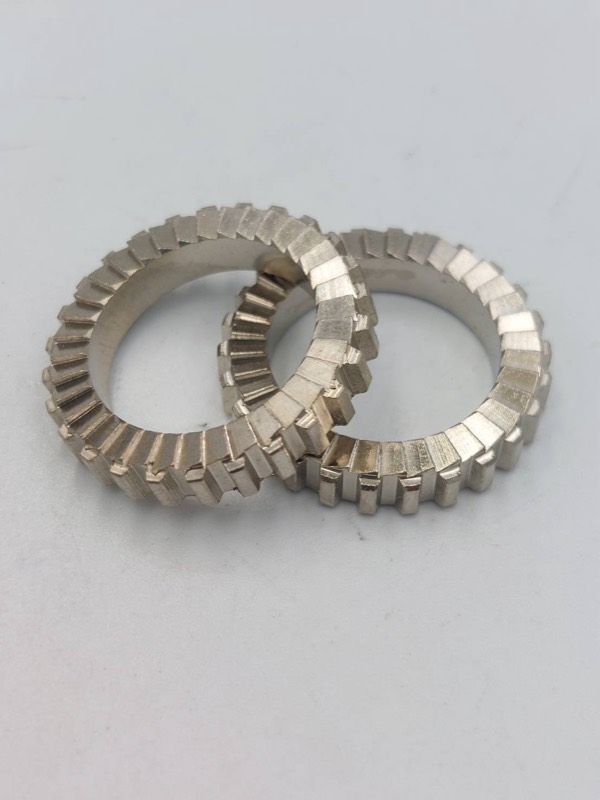
Wire EDM is the right choice for hardened steel, splines, ratchet teeth, narrow slots and sharp outside corners. For simple outlines in soft material, milling, laser cutting or waterjet cutting can be faster and cheaper, and for blind pockets wire EDM is not possible at all. If you are unsure, send the drawing and ask the shop which process it would use and why.
Wire EDM at Chi Xin
Chi Xin Technology is a CNC machine shop in Nantun District, Taichung, Taiwan, founded in 2022. We run 5+ CNC machines — 4.5-axis CNC machining centers and CNC lathes — and mainly machine aluminum alloys and alloy steel, with a metal tolerance of 0.02 mm. We also offer wire EDM and surface finishing including anodizing, and we export to customers in Europe and North America.
We quote wire EDM together with the turning or milling of the same part, so the start holes, datums and machining sequence are planned once. Send the DXF of the profile with your drawing, the material and the quantity, and mark which profiles carry the tight tolerances.
Frequently asked questions
Why is wire EDM more expensive than milling?
Wire EDM removes material slowly along a line through the full thickness, and accurate profiles need several passes. For hardened steel, fine splines or sharp corners it is often the only practical method; for simple outlines in soft material, milling is usually cheaper.
How is wire EDM usually quoted?
Mostly from estimated machine time — cut length times thickness, the number of skim passes and the number of start holes — plus setup. Quantity matters because setup is shared across the batch.
Does hardened steel cost more to wire cut?
Hardness itself does not slow the wire. The material grade and thickness matter more, which is why hardened parts are often wire cut after heat treatment.
How can I reduce the cost of a wire EDM part?
Tolerance only the critical profiles, allow the largest inside corner radius the function permits, reduce the number of closed internal profiles, order a realistic batch and ask whether thin parts can be stacked.
What do I need to send for an accurate quote?
A 1:1 DXF of the profile, the full drawing or 3D model, material grade and hardness, the tolerances per profile, the quantity and any finish requirement.