The four port families you meet on machined hydraulic parts are BSPP parallel ports to ISO 1179 (sealed by a bonded washer or elastomer ring on a spot face), SAE straight-thread O-ring boss ports to SAE J1926-1 / ISO 11926-1 (UNF thread with an O-ring in a chamfer), metric O-ring ports to ISO 6149-1 (ISO 261 metric thread, often marked by a raised identification ridge), and tapered NPT/NPTF ports that seal on the thread. For new hydraulic designs, ISO 6149 is the family the ISO port standards themselves recommend; NPT is best kept out of manifolds.
A port is a thread plus a sealing geometry, and fittings are made for one geometry only — so a drawing that says just "M18x1.5" or "1/2-20" is incomplete. This guide explains what each port looks like, what the machinist needs on the drawing, and the mistakes that cause leaks or rejected parts. For the block design itself (material, passages, cross holes, testing) see our hydraulic manifold machining guide; for general thread callouts see the thread callout guide.
BSPP ports to ISO 1179
BSPP ports use the 55° parallel G thread of ISO 228-1. Because a parallel thread does not seal on its flanks, the seal sits on the spot face around the port: a bonded seal (a steel washer with a vulcanised rubber lip), an elastomeric sealing ring on the stud end, or a metal-to-metal edge on some stud-end types. ISO 1179-1 defines the port; the other parts of ISO 1179 define the stud ends.
- Typical callout: "Port ISO 1179-1 – G1/2" plus the stud-end or seal type if it affects the spot face.
- The spot face must be flat, square to the thread axis and free of tool marks across the seal contact zone — a burr or chatter ring is a leak path for a bonded washer.
SAE straight-thread O-ring boss: SAE J1926-1 / ISO 11926-1
The SAE O-ring boss (ORB) port uses a UN/UNF inch thread to ASME B1.1. The O-ring on the stud end is squeezed into a short conical chamfer at the top of the port, so the seal depends on the chamfer angle, diameter and surface finish, not on the thread. SAE J1926-1 and ISO 11926-1 describe the same port; fittings are often sold by dash size (for example -8 for 3/4-16 UNF).
- Typical callout: "Port SAE J1926-1 – 3/4-16 UNF-2B" (or ISO 11926-1).
- The O-ring chamfer and spot face are cut in one pass by a port form tool so they are concentric with the thread.
- Standard in North American mobile and industrial hydraulics.
Metric O-ring ports: ISO 6149-1
ISO 6149-1 ports use ISO 261 metric threads with an O-ring seated in a truncated housing at the port mouth — conceptually the metric equivalent of the SAE O-ring boss (SAE J2244 is the SAE counterpart). The ISO 6149-1 text gives working pressures up to 63 MPa for non-adjustable and 40 MPa for adjustable stud ends.
To stop someone fitting a BSPP or plain metric stud end, ISO 6149 ports can carry an identification ridge: a small raised ring on the spot face. It is optional; if it is not used, the port should be marked as metric next to the port or on the nameplate. If you want the ridge, say so on the drawing — it needs a form tool with the matching notch.
The ISO port standards recommend ISO 6149 for new hydraulic designs and advise against ISO 1179, ISO 9974 and ISO 11926 for new hydraulic applications. Many existing machines still use BSPP and SAE ports, so match what the rest of your system uses.
NPT and NPTF: why they are avoided in manifolds
NPT (ASME B1.20.1) and the dry-seal NPTF (ASME B1.20.3) seal by wedging a tapered thread into a tapered port, usually with sealant or tape. In a machined block this has drawbacks: the wedge loads the port wall radially and can crack aluminum or a thin section if over-tightened; each re-assembly seals less well; sealant fragments can contaminate the hydraulic circuit; and the fitting angle cannot be set without changing the make-up torque.
NPT is still common for gauge ports, drains and low-pressure lines in North America. If you must use it, give the thread size and standard, state that it is checked with an L1 plug gauge to the stand-off tolerance, and keep enough wall around the port.
Spot faces, wall thickness and port spacing
Every straight-thread port needs a flat seat for the fitting or washer. The standards give a minimum spot face diameter for each size; the fitting maker's catalogue usually shows it too. On cast or rough surfaces the spot face is cut deeper to clean up, so allow for that in passage positions.
- Spot face diameter: at least the standard minimum, and large enough that adjacent fittings and wrenches clear each other.
- Port spacing: check the hex across-corners size of the largest fitting, not just the thread size.
- Wall thickness: keep material between the port thread or chamfer and the nearest drilled passage; drill breakthrough into a thread or O-ring chamfer is a common scrap cause.
- Surface finish: the seal zone is often specified around Ra 1.6–3.2 µm; check the fitting maker's data for your seal type.
Port form tools and how ports are machined
Production ports are usually made with a drill, then a combined port form tool that cuts the counterbore, O-ring chamfer or spot face and thread relief in one plunge, then a tap or thread mill. Form tools exist per standard and per size (for example ISO 6149 tools with or without the identification notch, SAE J1926 tools, ISO 1179 tools). Using one tool per port keeps the geometry concentric and repeatable.
Thread milling instead of tapping is common for large ports and in tough steels, because it gives control over the pitch diameter and avoids broken taps in expensive blocks.
How to call out ports on the drawing
Give each port a label and put the details in a port table on the drawing:
- Port ID (P, T, A, B, G1…), standard and size: "ISO 6149-1 – M22x1.5", "SAE J1926-1 – 9/16-18 UNF", "ISO 1179-1 – G3/8".
- Identification ridge required or not (ISO 6149).
- Usable thread depth and drill depth if close to another passage.
- Spot face diameter if larger than the standard minimum.
- Protection: plastic caps or plugs after cleaning, and whether threads are masked during finishing.
- Pressure test requirement, if any — tell us in the RFQ and we confirm in the quotation what can be done.
Hydraulic ports at Chi Xin
Chi Xin Technology is a CNC machine shop in Nantun District, Taichung, Taiwan, founded in 2022. We run 5+ CNC machines — 4.5-axis CNC machining centers and CNC lathes — and mainly machine aluminum alloys and alloy steel, with a metal tolerance of 0.02 mm. We also offer wire EDM and surface finishing including anodizing, and we export to customers in Europe and North America.
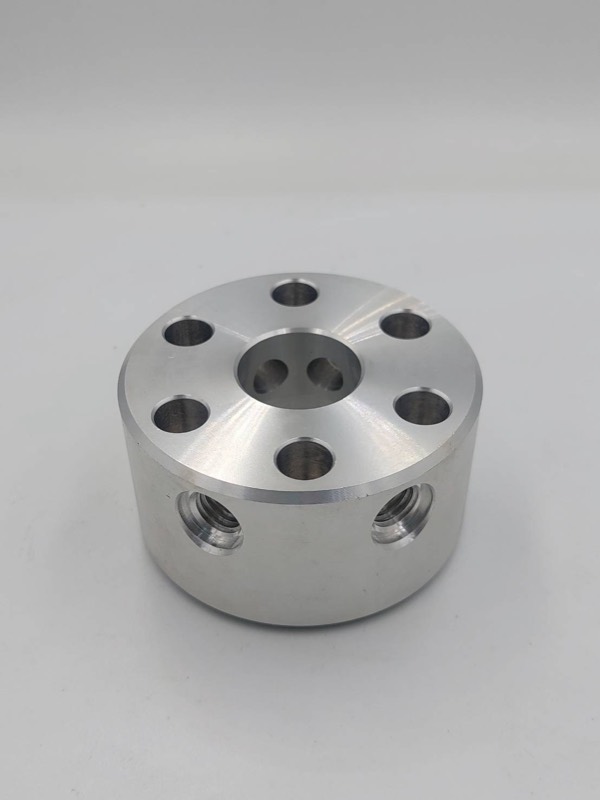
We machine manifold and distributor blocks and other hydraulic parts in aluminum and alloy steel on our 4.5-axis machining centers; send the port table with your drawing and we confirm port tooling and inspection in the quotation.
Frequently asked questions
Can a BSPP fitting be used in an ISO 6149 port?
No. The threads are different (55° G thread vs 60° ISO metric) and so is the sealing geometry. The identification ridge on ISO 6149 ports exists to make this mix-up visible.
Are SAE J1926-1 and ISO 11926-1 ports the same?
They describe the same inch straight-thread O-ring port, so a drawing can quote either. Name one so that the shop and the inspector use the same dimensions.
Why not just use NPT everywhere?
NPT seals by thread interference and sealant, which loads the port wall, makes repeated assembly less reliable and can contaminate the system. Straight-thread O-ring ports seal on a defined geometry and can be re-made many times.
Do I need to specify the spot face if the standard already defines it?
Only if you need it larger than the standard minimum, for example for wrench clearance or a different fitting. Otherwise the port standard callout is enough.
Can you pressure test or clean blocks to a cleanliness code?
Tell us the test pressure or cleanliness requirement in the RFQ and we confirm in the quotation what we can provide.