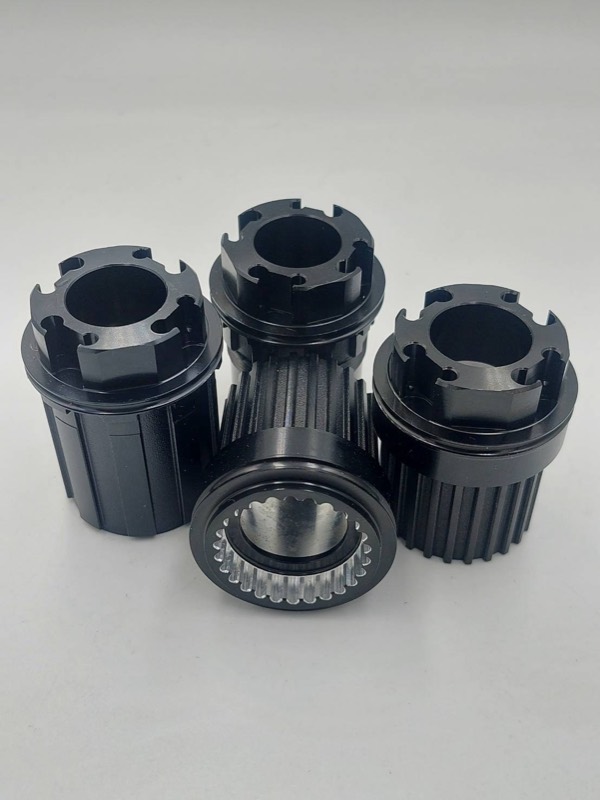
A custom freehub body is a turned-and-milled part with three jobs: carry the cassette on a standard spline or driver interface, transmit pedaling torque into the hub through pawls or a ratchet, and run true on two bearings. Most of the machining effort goes into the cassette interface and the drive interface; most of the field failures come from the material choice and the bearing seats.
This guide is for hub designers and small wheel brands who want freehub bodies made to their own design. It covers the main cassette standards, steel versus aluminum, the drive interface, the tolerances that matter and what a machine shop needs in your request for quotation.
Cassette interfaces you will be asked about
The cassette side of the body is defined by the drivetrain maker, not by you. These interfaces are not interchangeable, so a hub family usually offers several bodies on one shared drive interface. Always machine to the drivetrain maker’s current drawing or to a measured genuine part — never to a sketch copied from a forum.
- Shimano HG (Hyperglide): the long-running spline for 8–11 speed cassettes; the smallest cog it can carry is 11T. The road 11-speed version is longer, and 8/9/10-speed cassettes need a 1.85 mm spacer on it.
- Shimano Micro Spline: introduced for Shimano 12-speed MTB with a 10T smallest cog. It uses 23 fine splines and a shorter body so the 10T cog sits beyond the end of the body.
- SRAM XD: a driver body with a threaded interface that lets a 10T cog overhang the body. Common on 1x mountain bikes.
- SRAM XDR: the road/gravel version of XD, 1.85 mm longer. XD cassettes fit an XDR body with a 1.85 mm spacer.
- Campagnolo N3W: Campagnolo’s body for Ekar 13-speed (9T smallest cog). It keeps the classic Campagnolo groove profile but is 4.4 mm shorter; with the correct lockrings and adapters it also takes Campagnolo 10–12 speed cassettes.
Steel, aluminum or aluminum with steel inserts
Cassette cogs are thin steel plates. Under high torque the individual cog edges press into an aluminum spline and carve grooves — the familiar “cassette bite” or notching that makes cassettes hard to remove and creaky. The choice of body material is a trade-off between weight and this wear.
- Aluminum (typically 7075-T6): lightest; usually hard anodized for wear. Bite is acceptable for road riders, a known complaint on high-torque MTB and e-bike use.
- Aluminum with steel anti-bite inserts: steel strips or a steel sleeve pressed or bonded into the most loaded splines. Adds machining operations and an assembly step, but keeps most of the weight saving.
- Steel (alloy steel such as 4140/42CrMo4 or similar): no visible bite and the most durable, at a clear weight penalty. Often heat treated and protected by plating or black oxide.
- Fine-spline designs such as Micro Spline spread the load over more contact faces, which reduces notching on aluminum bodies.
The drive interface: pawls, drive rings and ratchets
On the hub side, the body either carries pawls that engage a toothed drive ring in the hub shell, or it carries one half of a face-ratchet (star-ratchet) pair. Engagement angle is simply 360° divided by the number of engagement positions. A 36-tooth ring with all pawls engaging together gives 10°; offset (phased) pawls multiply the positions — the same 36-tooth ring with two phases gives 5°.
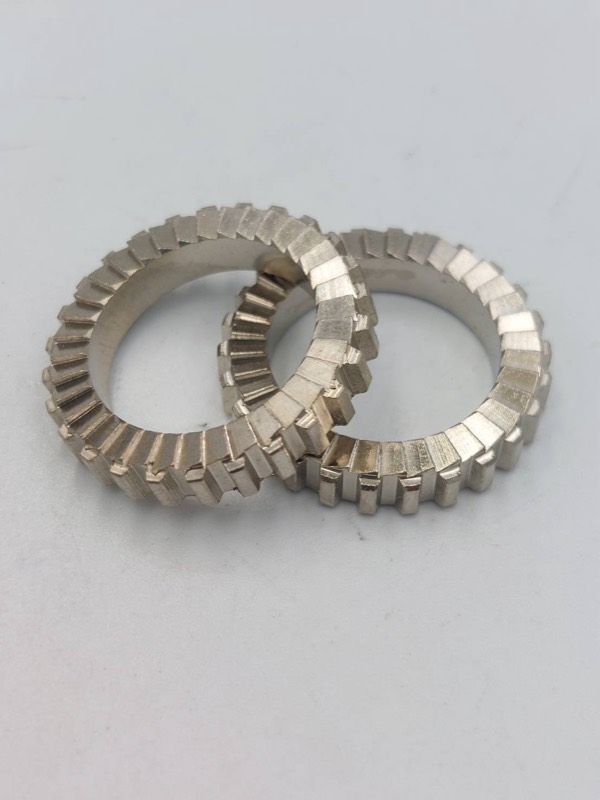
Machining detail matters more than the arithmetic. Pawl pockets need consistent depth and a crisp seat face so every pawl carries load; uneven pockets mean one pawl does the work and wears out early. Ratchet teeth and drive-ring teeth are usually hardened steel and are often cut or finished by wire EDM, broaching or a dedicated milling operation, with the tooth form, flank angle and count taken from your design.
Tolerances that decide whether it spins true
Most freehub bodies run on two sealed cartridge bearings. The two bearing seats must be concentric to each other and to the cassette spline, or the cassette wobbles and the bearings load unevenly. Turn both seats and the spline datum in one setup wherever the geometry allows it.
- Bearing seats: specify the bearing (e.g. by its ISO designation) and the fit class per ISO 286 — do not leave it as a nominal diameter.
- Runout of the spline major diameter to the bearing axis: call it out with a geometric tolerance per ASME Y14.5 or ISO 1101.
- Shoulder faces that locate bearings: perpendicularity to the axis, so preload does not tilt the bearing.
- Seal lands: surface roughness on the faces a lip seal or labyrinth runs against.
- Lockring thread: thread the body exactly as the cassette maker specifies; get the thread data from their documentation or a genuine part.
Finishing and heat treatment
Aluminum bodies are commonly hard anodized for wear resistance. Hard anodizing builds up roughly half its thickness on each surface, so splines, bearing seats and threads must be machined with allowance or masked. Steel bodies and ratchet rings are usually hardened to the designer’s specification, and features that must stay accurate after heat treatment may need finishing afterwards. State on the drawing which dimensions apply after coating or heat treatment.
What to send in your freehub RFQ
- 3D model (STEP) and 2D drawing, with the cassette standard named on the drawing
- Material and condition, plus any heat treatment and hardness to be reached
- Finish: anodize type and color, plating or black oxide, and masked surfaces
- Bearing designations and the fit you want on each seat
- Pawl or ratchet geometry, number of teeth and any parts you supply yourself (pawls, springs, seals)
- Prototype quantity, first batch and expected yearly volume
Freehub bodies at Chi Xin
Chi Xin Technology is a CNC machine shop in Nantun District, Taichung, Taiwan, founded in 2022. We run 5+ CNC machines — 4.5-axis CNC machining centers and CNC lathes — and mainly machine aluminum alloys and alloy steel, with a metal tolerance of 0.02 mm. We also offer wire EDM and surface finishing including anodizing, and we export to customers in Europe and North America.
Freehub bodies combine turned bearing seats with milled splines and pawl pockets, which is the mix of CNC lathe, 4.5-axis machining and wire EDM work we do; the freehub body and ratchet ring photos on this page are parts from our shop.
Frequently asked questions
Can one hub shell accept several freehub bodies?
Yes, that is how most hub brands work: the drive interface and bearing layout stay the same and only the cassette side changes between HG, Micro Spline, XD/XDR or N3W bodies. Design the shared interface first, then the variants.
Is a steel freehub body worth the weight?
For high-torque use such as e-MTB and heavy riders, often yes, because it does not notch. For road and lightweight builds, a hard anodized 7075 body or one with steel inserts is the usual compromise.
How do I get more engagement points without weaker teeth?
Phase the pawls instead of adding ever-smaller teeth. Two or three phases on a moderate tooth count give fine engagement while each tooth stays strong enough to machine and harden reliably.
Do you hard anodize or heat treat freehub bodies?
Tell us the anodizing type, hardness or heat treatment specification you need in the RFQ and we confirm it in the quotation.
Can you copy an existing freehub body from a sample?
We need a drawing you have the rights to use. If you own the design but only have samples, tell us in the RFQ and we discuss how to define the critical dimensions together.