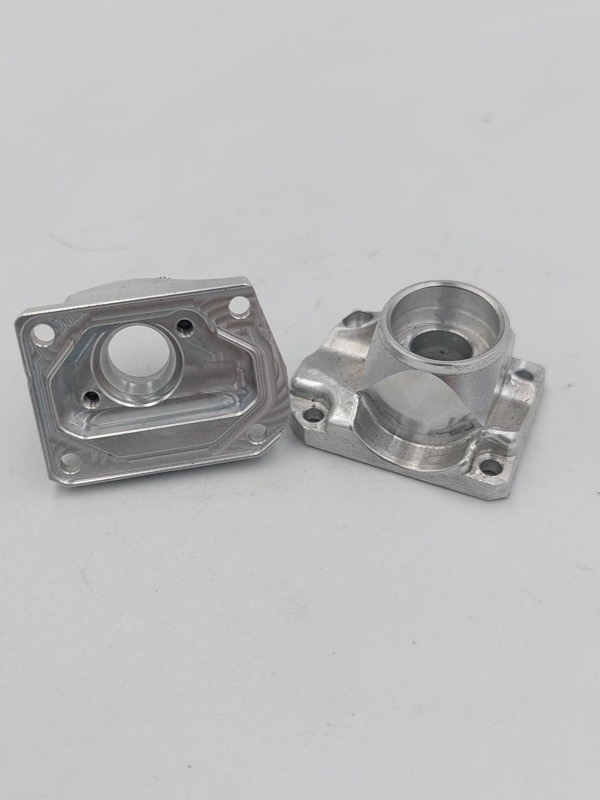
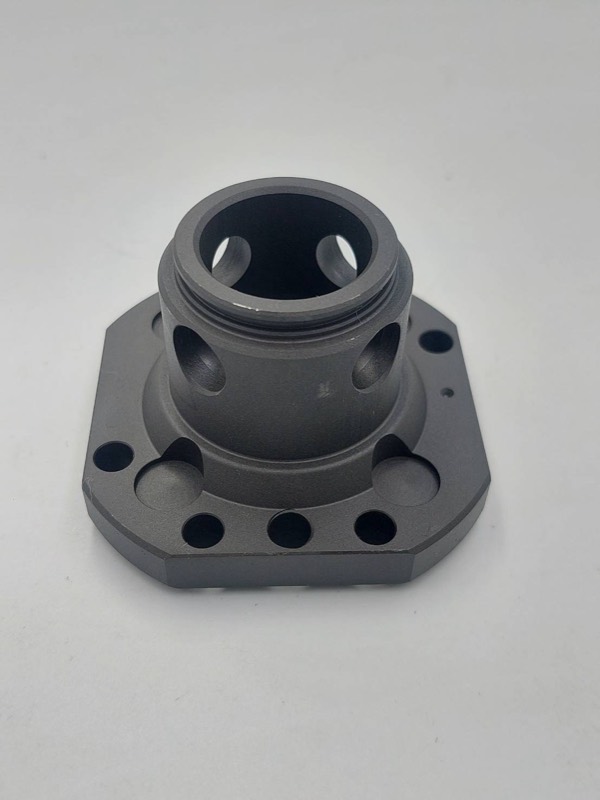
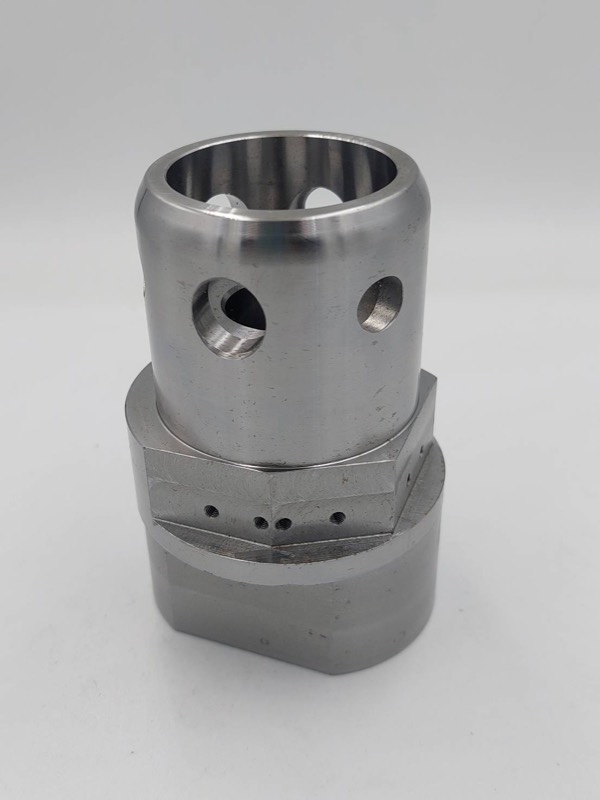
Machine a custom flange when the standard catalogue does not fit: a non-standard bolt circle, an integrated spigot or O-ring groove, a flange that is part of a valve body or housing, an unusual material such as aluminum, or a size and pressure combination that EN 1092-1 or ASME B16.5 does not cover. If a standard pipe flange fits your pipe size and pressure class, buy it — it is cheaper and comes with rated pressure-temperature tables.
Custom flanges are mostly turned parts with drilled bolt holes, and most of the cost and the risk sit in a few features: the sealing face, the bolt circle and the registers that locate the mating part. This guide covers the decision, the tolerances that matter and the blank choice.
Standard flange or custom flange?
EN 1092-1 covers steel flanges by DN and PN rating with type numbers such as Type 01 (plate), Type 05 (blind) and Type 11 (weld neck). ASME B16.5 covers pipe flanges and flanged fittings from NPS 1/2 to NPS 24 in Classes 150 to 2500. Both give dimensions, bolt patterns and pressure-temperature ratings.
- Buy standard: plain pipe connections in steel or stainless steel at a listed size and rating.
- Machine custom: equipment flanges (pump, gearbox, motor or valve mounting), flanges with spigots, O-ring grooves or sensor ports, aluminum or non-standard alloys, thin or lightweight designs, and flanges integrated into a larger part.
- Hybrid: a standard bolt pattern on a custom body, so the part still mates with standard pipe flanges. State which standard the bolt pattern follows.
- Pressure rating: a custom flange has no table rating. The pressure capacity is the designer's calculation, not the machine shop's.
Bolt circle and bolt hole tolerances
Bolt holes are clearance holes, so position matters more than diameter. Pipe flange standards size the holes larger than the bolt — in ASME B16.5 the hole is typically 1/8 in larger than the bolt — and place them to straddle the centrelines.
- Dimension the bolt circle diameter (PCD) as basic and control hole positions with a position tolerance, rather than ± tolerances on X and Y.
- Use the floating-fastener formula as a check: position tolerance ≈ hole minimum diameter minus bolt diameter, split between the two parts that bolt together.
- State whether holes straddle or sit on the centrelines; mirrored flanges that do not line up are a classic error.
- Threaded bolt holes (for studs) need a tighter position than clearance holes because there is no float on that side.
Sealing face: flatness, finish and gasket type
The gasket type sets the face. Flat face (FF, EN 1092-1 Type A) flanges use a full-face gasket inside and outside the bolts, and are used against cast iron or non-metallic mating flanges so the bolts do not bend the flange. Raised face (RF, Type B) flanges concentrate the gasket load on a ring inside the bolts; in ASME B16.5 the raised face is 1/16 in (1.6 mm) high for Classes 150 and 300. Do not bolt an RF flange to a brittle FF flange.
- Spiral-groove ("phonographic") gasket faces for sheet gaskets are commonly specified around 125–250 µin Ra, roughly 3.2–6.3 µm Ra — smoother is not better for soft gaskets.
- O-ring grooves and metal seals need a much smoother finish; follow the seal maker's groove data.
- Flatness: specify it on the sealing face only, and in proportion to the gasket — soft gaskets tolerate more than O-ring or metal-to-metal joints.
- Radial scratches across the seal face are rejectable on most gasket faces; say so if it matters.
Registers, spigots and squareness
Many custom flanges locate the mating part with a spigot (male register) and recess (female register). Give these an ISO 286 fit, for example H7/g6 for a locating register that must assemble easily, and control perpendicularity of the face to the bore or spigot axis. Turning the face, bore and spigot in one setup is the cheapest way to hold them true to each other.
Material and blank: bar, plate or forging
The blank decides both cost and integrity:
- Round bar: best for small flanges up to the bar sizes stocked; grain runs along the axis, which is fine for most equipment flanges.
- Plate (cut ring or disc): economical for large, thin flanges; check the plate grade, and note that through-thickness properties are lower than in-plane.
- Forging or forged ring: preferred for pressure flanges and weld necks, and where codes call for forged material; more expensive and needs minimum quantities from the forge.
- Aluminum (6061, 6082) for lightweight equipment flanges and vacuum or low-pressure duty; alloy steel such as 4140 for high bolt loads; stainless steel for corrosive media.
- If the flange will be welded, state the welding grade so the material chosen is weldable.
What to put on a custom flange drawing
- Material grade and blank form if it matters (bar, plate, forging) and the inspection document you need, such as EN 10204 type 3.1.
- Bolt circle as basic, hole size, position tolerance, and orientation to the centrelines.
- Face type (FF, RF, groove), raised face height, finish and flatness on the seal zone.
- Register fits and perpendicularity of the face to the axis.
- Bore size and tolerance, and any weld preparation.
- Finish or coating, and masking of sealing faces.
- If the bolt pattern copies a standard, write "Bolt pattern per EN 1092-1 PN16 DN100" or the ASME equivalent.
Custom flanges at Chi Xin
Chi Xin Technology is a CNC machine shop in Nantun District, Taichung, Taiwan, founded in 2022. We run 5+ CNC machines — 4.5-axis CNC machining centers and CNC lathes — and mainly machine aluminum alloys and alloy steel, with a metal tolerance of 0.02 mm. We also offer wire EDM and surface finishing including anodizing, and we export to customers in Europe and North America.
Our CNC lathes turn the faces, bores and registers of flanges and valve bodies and our machining centers drill and mill bolt patterns, so tell us your gasket and face requirements in the RFQ and we confirm them in the quotation.
Frequently asked questions
Can you machine a flange to EN 1092-1 or ASME B16.5 dimensions?
We can machine to the dimensions you give, but a standard pressure rating also depends on approved material and marking. For plain pipe connections a catalogue flange is usually the better buy; custom machining makes sense when the flange has extra features.
RF or FF — which should I choose?
Use FF against cast iron, plastic or other brittle mating flanges, with a full-face gasket. Use RF for steel-to-steel joints with ring gaskets, where the higher seating stress helps sealing.
What surface finish should the gasket face have?
For common sheet gaskets on RF faces, a spiral groove finish of roughly 3.2–6.3 µm Ra is typical. O-ring and metal seals need smoother faces — follow the seal maker's data.
Is an aluminum flange a good idea?
For light equipment flanges and low-pressure or vacuum duty, often yes. Check bolt preload against the aluminum bearing stress and use washers or steel inserts where needed.