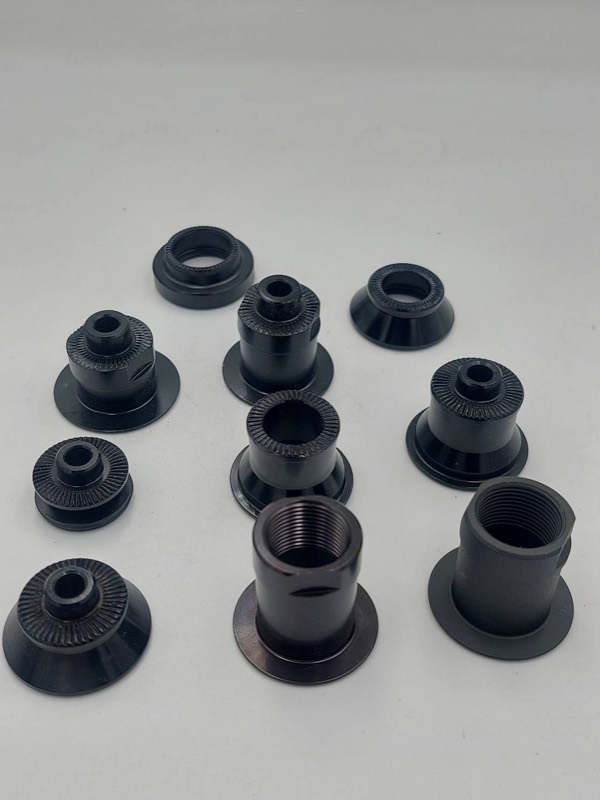
Bicycle lock rings, end caps and threaded caps are small turned parts with outsized consequences: a lock ring that does not fit the standard tool, galls on its thread or loses preload will make a premium hub feel cheap. Get three things right — the thread, the tool interface and the material/finish pairing — and these parts are straightforward to CNC machine in batches.
This guide covers cassette and rotor lock rings, bearing preload rings, end caps and decorative threaded caps, and what to put on the drawing for each.
Know which kind of ring you are making
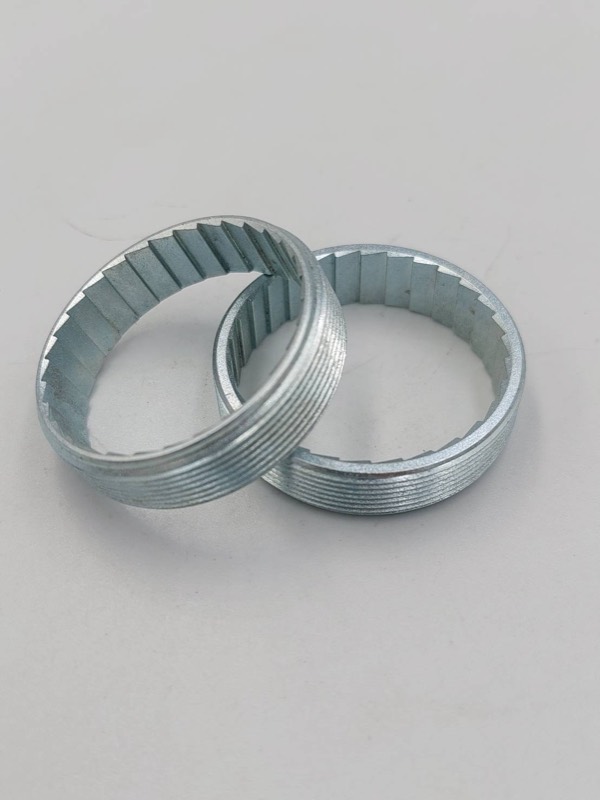
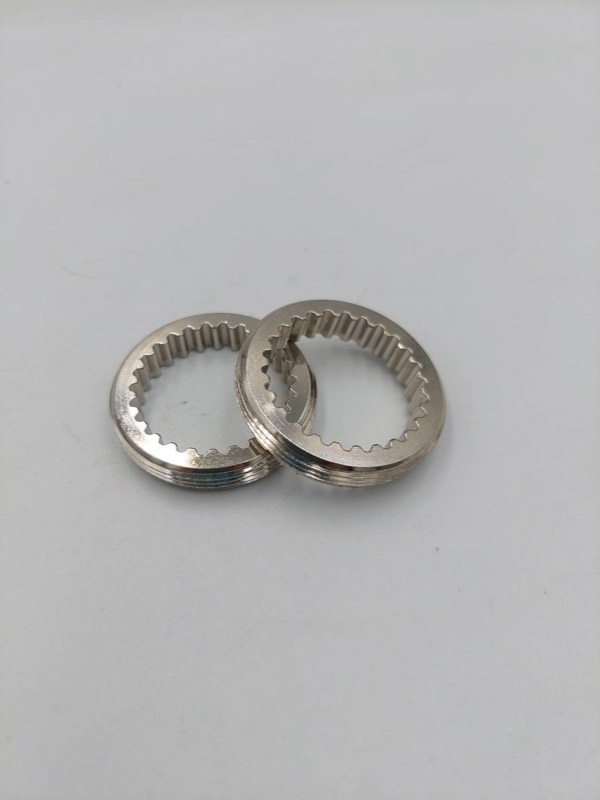
- Cassette lock rings: hold the cassette on the freehub. The thread and outer profile are set by the cassette and freehub standard; the common tool interface is 12 internal splines.
- Disc rotor lock rings (Center Lock type): hold the rotor on the hub splines. Internal-spline versions use the same tool as cassette lock rings; external-serration versions for 15/20 mm thru-axle hubs use a bottom-bracket-style tool.
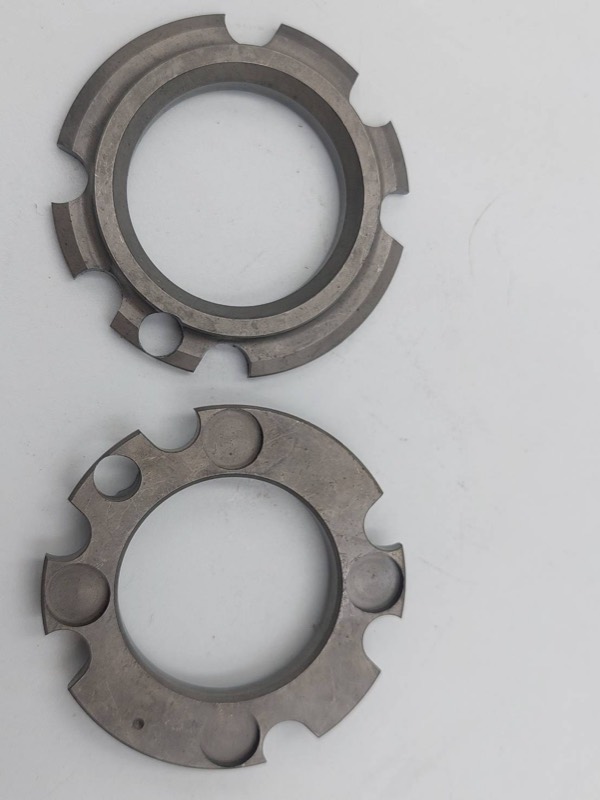
- Bearing preload rings and adjusters: set preload on the hub or freehub bearings, usually on a fine-pitch thread with a clamp screw or friction element to lock them.
- End caps: set hub spacing and seal the bearings (see the hub axle standards guide).
- Threaded and decorative caps: top caps, axle caps and dust caps where appearance matters as much as function.
Threads: name the standard, not just the size
Bicycle threads mix systems. Some are metric (ISO 261 sizes, tolerance classes per ISO 965); others combine a metric or inch diameter with an inch pitch — for example English (BSA) bottom brackets are 1.370 in × 24 TPI and Italian bottom brackets 36 mm × 24 TPI. Cassette lock ring threads are defined by the freehub or cassette maker. Take the thread data from that maker’s technical documents or check a genuine part with thread gauges — do not copy a size from a forum post or a reseller listing.
- Give the thread designation, pitch, hand (left-hand threads exist on bicycles, such as the drive-side cup of a BSA bottom bracket) and tolerance class.
- For fine adjustment, preload rings typically use fine metric pitches such as 1.0 mm; smaller pitch means finer adjustment per turn but less thread strength.
- Specify whether the class applies before or after anodizing or plating.
- Ask for a chamfer or partial thread relief at the start so rings start without cross-threading.
Tool interfaces
If your ring uses a standard tool interface, copy the interface exactly. The widely used cassette-lockring fitting has 12 splines about 23.4 mm across with clearance for a 12 mm axle (the Park Tool FR-5.2 and Shimano TL-LR15 fit it). A ring that is a fraction too tight will not accept the tool; one that is too loose lets the tool cam out and chew the anodizing.
Proprietary interfaces — pin spanner holes, face slots, hex flats or a custom spline — protect your brand’s look and can be machined just as well, but you then need to supply or recommend the tool. Pin holes and slots are milled after turning; internal splines are usually made by wire EDM, broaching or shaping depending on volume.
Aluminum or steel?
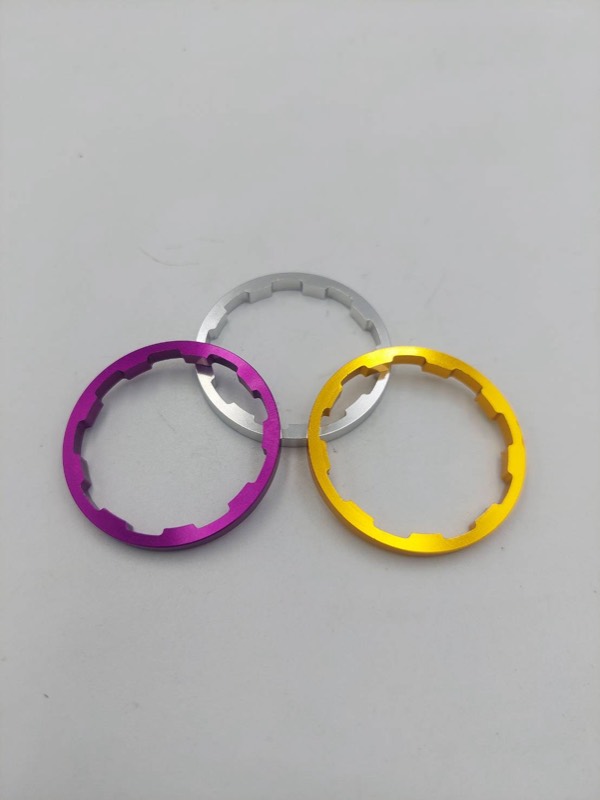
- Anodized aluminum (6061-T6 or 7075-T6): light and colorful; the default for visible rings and caps. Aluminum on aluminum threads can gall, so use a thread compound and avoid repeated high-torque cycles.
- Steel (carbon or alloy steel, plated or black oxided): for rings that see high torque or frequent removal, such as some cassette lock rings, and where a hardened tool interface is needed.
- Hybrid: an aluminum ring on a steel freehub, or a steel ring on an aluminum body, reduces galling between like materials.
- Stainless steel: sometimes used for small caps where corrosion matters and no coating is wanted.
Tolerances for preload and sealing
A preload ring only works if its clamping face is square to the thread. If the face runs out, the bearing is loaded on one side and preload changes as the hub turns. Call out the perpendicularity or runout of the clamping face to the thread axis, and the flatness of faces that seal against a bearing or end cap.
For cassette and rotor lock rings, the clamping face and the tool interface are the critical features; outer cosmetic diameters can stay at a general tolerance per ISO 2768. Thin rings can deform when clamped for turning, so the drawing should state that roundness applies in the free state if that is what you check.
Cosmetic requirements
Small anodized rings are visible on the bike, so cosmetic rules belong on the drawing: which faces are A-surfaces, acceptable scratch size, where a rack contact mark may sit, edge break size, and the surface finish before anodizing (machined, brushed or blasted). Laser-marked logos or torque values should be positioned so the tool does not wear them off. Pack anodized rings so they do not touch each other in transit.
Lock rings and caps at Chi Xin
Chi Xin Technology is a CNC machine shop in Nantun District, Taichung, Taiwan, founded in 2022. We run 5+ CNC machines — 4.5-axis CNC machining centers and CNC lathes — and mainly machine aluminum alloys and alloy steel, with a metal tolerance of 0.02 mm. We also offer wire EDM and surface finishing including anodizing, and we export to customers in Europe and North America.
Lock rings, threaded caps and end caps are turned on our CNC lathes, with milled tool interfaces and anodizing as needed; the lock ring and cap photos on this page are parts from our shop.
Frequently asked questions
What thread does a Shimano-compatible cassette lock ring use?
Use the thread specified by the freehub or cassette maker, or check a genuine lock ring with thread gauges. Put the confirmed thread and tolerance class on your drawing and we machine to it.
Why does my anodized lock ring feel tight on the thread?
Anodizing builds up on the thread flanks. Either mask the thread or machine it with allowance so the class is met after coating.
Can a lock ring use the standard 12-spline tool?
Yes, if the internal splines are copied exactly from the standard interface. Send the interface dimensions or a reference part and mark them as critical on the drawing.
Do you supply rings in several anodize colors?
Each color is a separate anodizing run. Tell us the colors and quantity per color in the RFQ and we confirm them in the quotation.