A bicycle hub axle has to match two things you do not control — the frame or fork dropout standard and the bearings you choose — and one thing you do: how the axle, end caps and spacers stack up between them. For a modern disc-brake hub that usually means a hollow axle sized for a 12 mm or 15 mm thru-axle, with spacing of 100 or 110 mm at the front and 142 or 148 mm at the rear.
This guide explains the common axle standards, how each one changes the parts you need to machine, which materials suit which design, and what to specify so axles and end caps fit the first time.
Quick reference: common hub spacing and axle sizes
Spacing is the over-locknut dimension (OLD) — the distance between the outer faces of the end caps that sit in the dropouts. The axle diameter is the thru-axle or skewer that clamps the wheel.
- Quick release, front: 100 mm spacing; hollow hub axle (typically 9 mm) with a skewer through it.
- Quick release, rear: 130 mm (road) or 135 mm (MTB, disc road); hollow hub axle (typically 10 mm).
- Thru-axle 12 × 100 mm front and 12 × 142 mm rear: today’s disc road and gravel standard.
- Thru-axle 15 × 100 mm front and 12 × 142 mm rear: non-Boost mountain bike.
- Boost 15 × 110 mm front and Boost 12 × 148 mm rear: current mountain bike standard. Boost 110 moves each front flange 5 mm outward; Boost 148 moves each rear flange about 3 mm outward, improving spoke bracing angle and wheel stiffness.
How the standard changes the parts you machine
On a quick-release hub the axle itself is the structural member: it carries the bending load between bearings and dropouts, is threaded on both ends for cones or locknuts and is usually steel. On a thru-axle hub the thru-axle carries most of the load, so the hub axle becomes a stiff tube that positions the bearings and carries the end caps. It can be aluminum, larger in diameter and lighter.
Boost and non-Boost hubs often share the same axle and bearings; the difference is mostly in the shell (flange positions) and the end caps. That is why many small brands offer conversions by end cap: one axle, several cap sets. Plan the cap interface so it stays the same across your range.
End caps and spacers
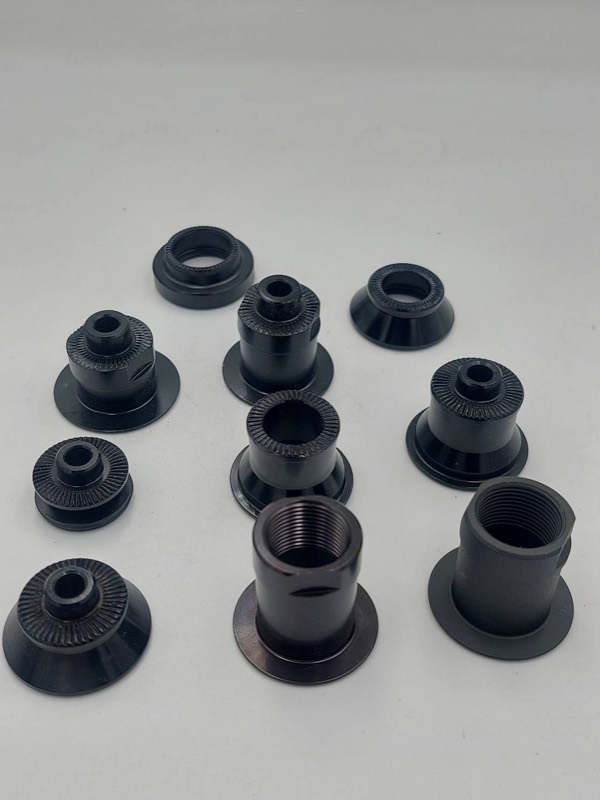
End caps set the final spacing, centre the wheel and carry the clamping force from the dropouts into the bearing inner rings. Because they are small turned parts, they are cheap to remake — which makes them the right place to absorb standard changes.
- Fit to axle: slip fit with an O-ring, a press fit or a thread. Slip-on caps are tool-free for conversions but need a controlled diameter so they neither fall off nor need a press.
- Outer face: flat and perpendicular to the axis, because it clamps against the dropout.
- Stack-up: the axle length, both cap lengths and any spacers add up to the OLD. Tolerance the stack so the total lands within your target, not each part at its tightest.
- Bore: matches the thru-axle with a small clearance (12 or 15 mm nominal) so the axle slides in without play.
Axle material: 7075 aluminum vs 4140 / chromoly steel
- 7075-T6 aluminum: the usual choice for thru-axle hub axles. High strength for an aluminum alloy, light, and it can be anodized. The thru-axle supports it, so the lower stiffness of aluminum versus steel matters less.
- 6061-T6 aluminum: easier to source and anodize evenly, but lower strength; mostly used for spacers and end caps rather than the axle itself.
- 4130 / 4140 chromoly steel: preferred for quick-release axles, which bend under load and rely on steel’s strength and fatigue behaviour. Usually plated or black oxided.
- Thru-axles themselves (the removable part) are a separate design problem; many are aluminum or steel with a threaded tip matched to the frame thread.
Bearing seats, fits and threads
Most cartridge-bearing hubs use common deep-groove sizes such as 6902 (15 × 28 × 7 mm), 6903 (17 × 30 × 7 mm), 6802 (15 × 24 × 5 mm) or 6803 (17 × 26 × 5 mm). In a hub the axle is stationary and the shell rotates, so the outer ring sees the rotating load and typically gets the tighter fit in the shell. The inner ring on the axle is usually a close sliding or light transition fit, which keeps assembly simple and lets preload pass through the inner rings.
Specify the fit with ISO 286 limits (for example an h6 or j6 range on the axle seat, chosen with your bearing supplier’s data), not with a bare nominal diameter. Hubs with an adjustable preload use a fine-pitch thread on the axle and a lock ring or adjuster — give the thread with a tolerance class per ISO 965 and mark it as critical.
Machining notes that save a prototype round
- Turn both bearing seats in one setup or between centres so they are concentric; call out runout between them.
- Hollow axles: the bore and outer diameter must stay concentric along the length, which is harder on long, thin-wall tubes. Leave a sensible wall thickness.
- Add small undercuts or reliefs at bearing shoulders so the bearing sits flat against the face.
- Anodized aluminum axles: decide whether bearing seats are masked or machined with coating allowance.
- Mark the drive side on drawings for asymmetric rear axles, which helps avoid mixed-up assemblies.
Hub axles at Chi Xin
Chi Xin Technology is a CNC machine shop in Nantun District, Taichung, Taiwan, founded in 2022. We run 5+ CNC machines — 4.5-axis CNC machining centers and CNC lathes — and mainly machine aluminum alloys and alloy steel, with a metal tolerance of 0.02 mm. We also offer wire EDM and surface finishing including anodizing, and we export to customers in Europe and North America.
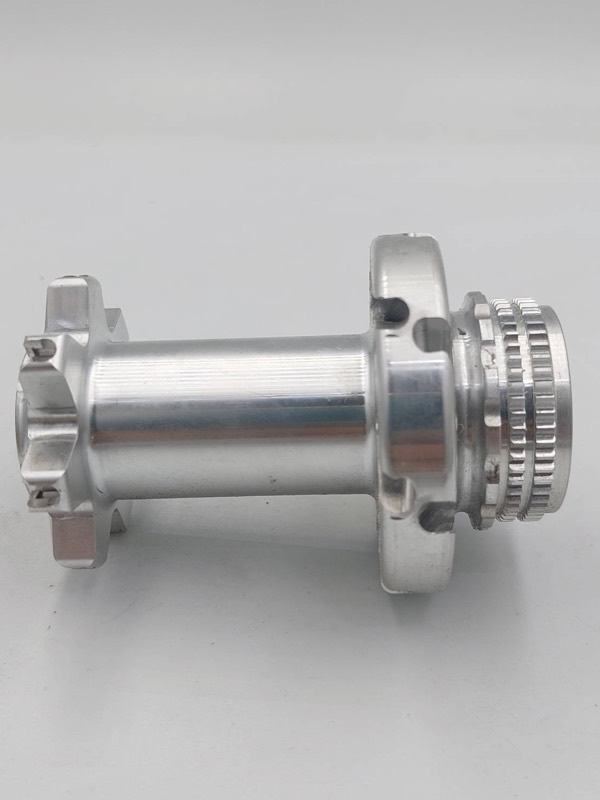
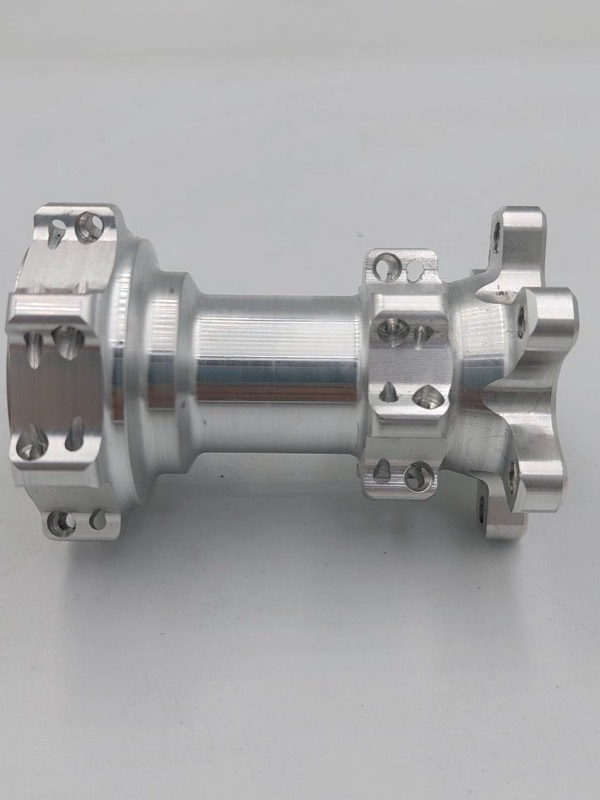
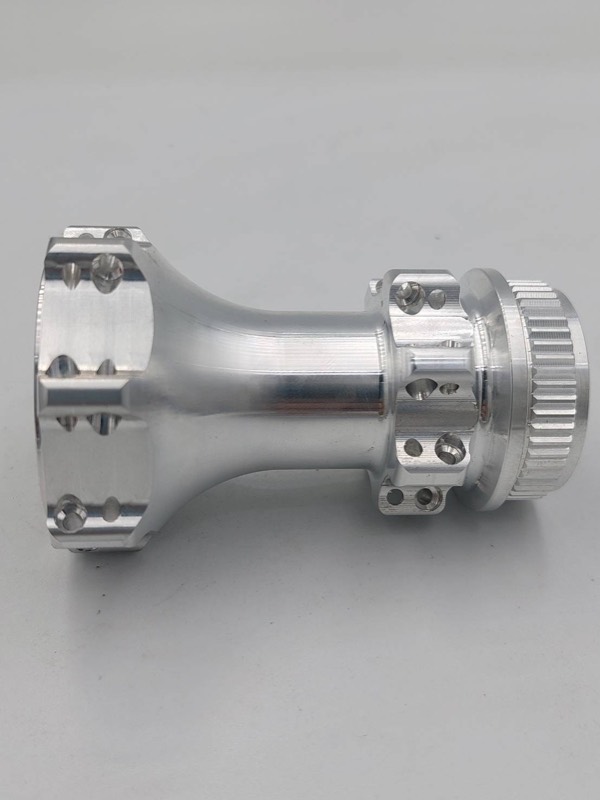
Hub axles and end caps are turned on our CNC lathes in aluminum alloys and alloy steel, and the axle and end cap photos on this page are parts from our shop; send your bearing choice and spacing standard and we review the critical fits with you.
Frequently asked questions
Should a new hub design still support quick release?
For most modern disc-brake bikes, no — 12 mm thru-axles dominate road and gravel, and Boost dominates mountain bikes. Some brands still offer QR end caps for older frames; designing the axle bore to accept QR caps keeps that option open.
Can one axle cover Boost and non-Boost?
Often yes. Many hubs share the axle and bearings and change only the end caps, but the shell flange position differs between Boost and non-Boost, so the shell itself is usually specific to one standard.
Is a 7075 axle strong enough for a quick-release hub?
It is possible but less common, because the QR axle carries bending loads itself. Chromoly steel remains the safer default for QR; 7075 is the default for thru-axle hubs.
What tolerance should a bearing seat have?
It depends on the bearing, the load and the materials. Choose a fit class with your bearing supplier’s recommendations, write it on the drawing per ISO 286, and we will check it against what we can machine before quoting.